Assisted Living or Memory Care? How Melbourne Families Can Decide
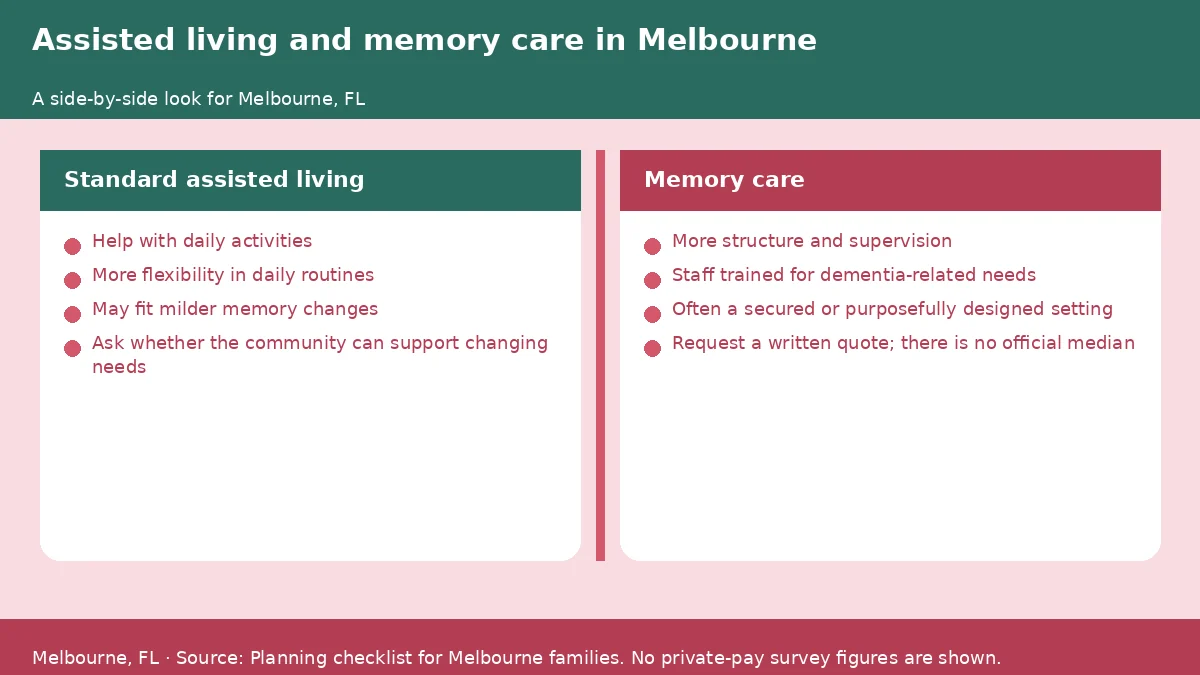
In Melbourne, memory care is a more structured setting than standard assisted living, often with additional staffing and security. Whether someone needs that setting depends on their safety and daily-care needs, not on a national average price. Ask communities for written quotes for both options when both are appropriate.
Medicare does not pay for room, board, or ongoing custodial care in assisted living if that is the only care someone needs (Medicare.gov: long-term care coverage).
Eligible wartime Veterans and surviving spouses can review VA pension with Aid and Attendance. As of December 1, 2025, the maximum annual pension rate with Aid and Attendance is $29,093 for a Veteran with no dependents and $34,488 for a Veteran with one dependent (current VA pension rates). A surviving spouse’s Aid and Attendance maximum is $18,697 a year with no dependent children (VA Survivors Pension rates). These are benefit limits, not the price of a Melbourne community. The net worth limit for these pensions is $163,699 from December 1, 2025, through November 30, 2026.
For local public-benefit counseling, start with the federal Eldercare Locator at 1-800-677-1116, which connects families to the Area Agency on Aging that serves Melbourne, Florida.
When a parent in Melbourne needs more support, families often hear two terms used almost interchangeably: assisted living and memory care. Both offer a safe place to live, meals, and help with daily life. But they are designed for different needs, and choosing the right one can make your parent's days calmer and safer and can help avoid a second move soon after the first. This guide explains the differences and offers practical ways to decide.
What assisted living offers
Assisted living is for older adults who are mostly independent but need help with some daily activities, such as bathing, dressing, managing medications, or getting to meals. Residents usually have a private or shared suite, choose their own activities, and keep much of their usual routine.
Florida licenses assisted living facilities through the Agency for Health Care Administration. Beyond the standard license, facilities may hold specialty licenses: Extended Congregate Care, which allows more help so residents can age in place; Limited Nursing Services, which allows certain nursing care by licensed nurses; and Limited Mental Health (AHCA, Assisted Living in Florida guide, PDF).
What memory care offers
Memory care is for people living with Alzheimer's disease or another dementia whose needs go beyond what standard assisted living can safely provide. It typically adds:
- A secure environment with monitored exits to reduce wandering
- Staff trained in dementia care, including calm redirection
- A predictable daily routine
- Activities matched to each person's abilities
- More hands-on help with eating, dressing, and personal care
Florida law requires any assisted living facility that advertises special care for Alzheimer's disease or related disorders to meet standards for awake staff or monitoring, activities for cognitively impaired residents, a safe environment, and staff dementia training (Florida Statutes, s. 429.178).
Memory care provides support and a safer setting. It does not reverse or cure dementia.
Side by side
| Assisted living | Memory care | |
|---|---|---|
| Who it serves | Older adults needing some daily help | People living with dementia |
| Environment | Open, more independence | Secured, simplified, calm |
| Staffing | Help with daily activities | More staff time and dementia training |
| Activities | Broad social calendar | Structured, ability-based |
| Cost | Lower | Higher |
The cost difference
It does not report memory care separately. See our guide to memory care costs in Melbourne.
Signs assisted living may fit
- Your parent needs help with a few tasks but follows conversations and makes choices
- Medication reminders and regular meals would solve most problems
- Your parent is lonely and would enjoy company
- Memory changes are mild and there is no wandering
- Your parent can use a call button reliably
Signs memory care may fit better
- Wandering or trying to leave, especially at night
- Getting lost on familiar routes, such as the drive to the beach or church
- Not recognizing hazards, like the summer heat or a hot stove
- Needing step-by-step help to dress or bathe
- Agitation or confusion that rises late in the day
Early dementia is a gray area
Many people in the early stages of dementia do well in assisted living with reminders and a steady routine. The question is how quickly needs may change. Ask your parent's doctor what to expect, and ask each community what happens if your parent later needs memory care: whether a move within the building is possible, how rates change, and who decides. A community offering both can make that transition gentler.
Hurricane season and dementia
On the Space Coast, storm preparation matters. Evacuations and power outages can be very disorienting for people living with dementia. Ask how each community plans for residents with memory loss during a storm, whether it shelters in place or evacuates, and how families are kept informed. Florida rules require an alternate power source able to keep indoor temperatures at or below 81 degrees for at least 96 hours after a power loss (Fla. Admin. Code R. 59A-36.025).
Try a short stay
Respite stays can show how a parent responds to a supportive setting, and give family caregivers a true break. Our guide to respite care in Melbourne explains how they work.
Get a medical view
A physician can help you understand your parent's abilities and likely needs. Bring a short log of recent incidents: missed medications, falls, getting lost, or unusual behavior. Specific examples help the doctor advise you.
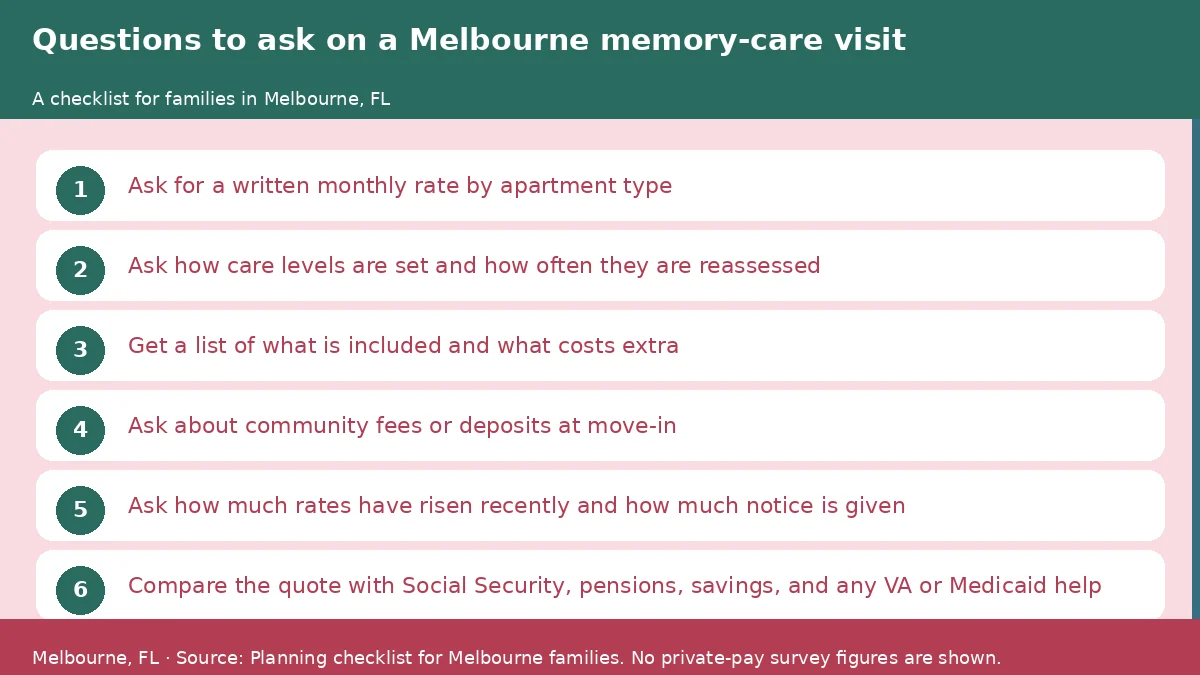
Questions to ask any community
- How do you decide between assisted living and memory care for a new resident?
- What dementia training do staff complete?
- How do you prevent and respond to wandering?
- How do you handle sundowning without relying on medication?
- What happens if my parent's needs exceed what you provide?
- How do charges change if my parent moves to memory care?
When family members disagree
Siblings often see a parent differently, especially when some live far away and visit only in winter. A shared written log, a joint doctor visit, and touring both settings together can help everyone reach the same picture. The goal is to find where your parent will be safe and comfortable.
Helping your parent adjust
Whichever setting you choose, the first weeks can feel unsettling. Familiar belongings, such as a favorite chair, a family quilt, or photos from years on the Space Coast, help a new room feel like home. Share your parent's routines, preferences, and life story with staff so they can connect with your parent as a person. Visit often at first, but take cues from staff about whether short, calm visits are working better than long ones. Many families find that after a few weeks, a parent who resisted the move begins to enjoy meals with others and a predictable day.
Local support
Senior Resource Alliance's Elder Helpline, 1-800-963-5337, can connect Brevard families with caregiver support and dementia resources (Senior Resource Alliance).
Talk with Hibiscus Court
Hibiscus Court, at 540 East Hibiscus Boulevard in Melbourne, offers both assisted living and memory care, as well as respite. Please call (321) 447-2934 to talk through which setting fits your parent and to ask about current availability.
Frequently asked questions
What is the main difference between assisted living and memory care?
Assisted living helps with daily activities in an open setting. Memory care adds a secure environment, dementia-trained staff, and structured routines for people living with dementia.
Can a person with dementia live in assisted living in Florida?
Many people in the early stages do well in assisted living. Facilities with an Extended Congregate Care license may supervise residents with dementia, and memory care may be safer as needs grow.
Is memory care more expensive?
Yes.
What does Florida require of memory care?
Facilities advertising Alzheimer's care must meet section 429.178 standards for awake staff or monitoring, activities, a safe environment, and staff dementia training.